Wisconsin Wine Industry Transparency and Craft
Wisconsin Wine Industry Transparency and Craft. "Discover how transparency in production can transform the Wisconsin wine industry. Learn how local wineries can move beyond the 'ghost section' with data-backed storytelling and craft authenticity to connect with today's selective drinkers."
FEATURE
7/19/20263 min read
The New Craft: Why Transparency Is the Key to Selling Local
Summary
Market Reset: The U.S. wine industry is experiencing a shift where volume is declining but premiumization (willingness to pay for quality) is increasing.
The Tariff Opportunity: New 15% tariffs on EU imports have hiked retail prices for many European labels, creating a massive opening for domestic producers to capture price-sensitive buyers.
Transparency as the Hook: Since many shoppers bypass the "Wisconsin Wine" section entirely, transparency regarding ingredients and production processes is a powerful tool to differentiate local brands and drive consumer interest.
The Power of Cooperatives: For small Wisconsin wineries, organizations like the Badger State Wine Cooperative provide a vital pathway to market, allowing them to fulfill wholesale orders without traditional third-party distributors.
Digital & Experiential Marketing: To succeed, wineries must bridge the gap between experiential in-store efforts and digital storytelling, using tools like QR codes and short-form video to educate consumers on their craft.
The aisles of your local supermarket are dominated by national giants. They have built their market on predictability, aggressive pricing, and massive distribution. For many shoppers, the "Wisconsin Wine" section is a ghost town—often bypassed in favor of familiar national labels.
But as a consumer, you don’t drink wine just to be "filled." You drink it to be moved. The challenge for local producers isn't just shelf space; it’s relevance.
Navigating the Distribution Maze
In Wisconsin, the law creates a high barrier to entry for small producers who must rely on permitted wholesalers. The Badger State Wine Cooperative offers a transformative solution. By operating as a non-profit farm cooperative, it allows small wineries to collectively fulfill wholesale orders. This model gives small producers more control over their brand and pricing—factors that are often lost when working with massive, multi-regional distributors.
Understanding the Retail Landscape & Varietal Gap
We are competing against an audience used to Chardonnay, Merlot, and Pinot Grigio—grapes that don't grow well in Wisconsin. The "ghost section" problem persists because consumers often associate local wine with sweet, dessert-style fruit wines. To bridge this varietal gap:
Don't apologize for the grape: Frame cold-hardy variatals like Marquette, Itasca, and Frontenac as the Wisconsin alternative to well-known global grapes.
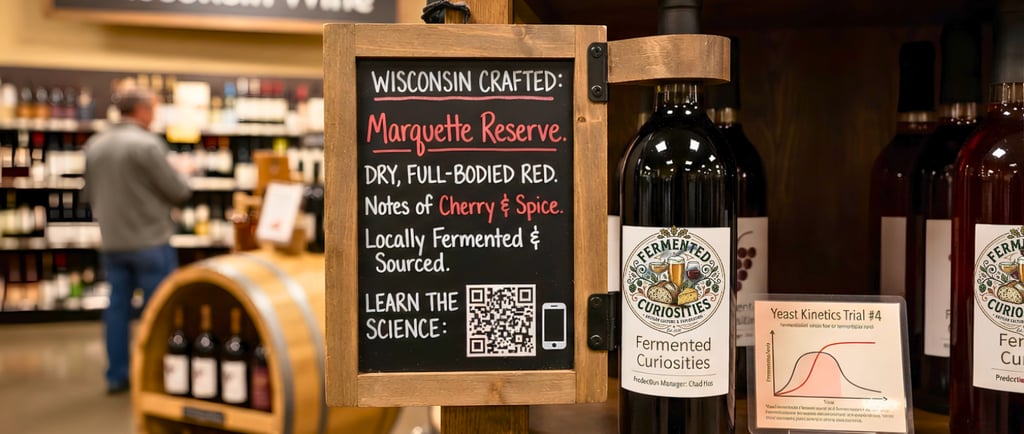
Define the profile: Clearly label wines as "Dry" or "Semi-Dry" on shelf-talkers to capture modern, selective drinkers.
Competitive Tactics for Retailers
To get products out of the "ghost section," we must move beyond passive placement:
Cross-Merchandising: Work with store managers to place wine near gourmet cheeses or seasonal displays.
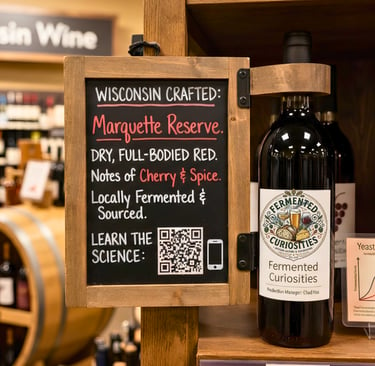
POS Transparency: Use chalkboard-style neck tags that define the flavor profile, essentially acting as an in-store consultant.
In-Store Demos: Data shows that the "experiential" nature of wine drives the industry. Live demos that explain the fermentation science or the characteristics of Wisconsin grapes break the "sweet wine" stereotype.
Digital Storytelling: QR Codes & Reels
While experiential marketing leads to higher conversion, digital marketing provides the scale necessary for brand building. Wineries are increasingly using:
QR Code Education: Place QR codes on all shelf-talkers or back labels that link to a 30-second "Meet the Maker" video or a technical deep-dive into the fermentation process.
Short-Form Video (Reels/TikTok): Use social media to demystify production. Content showing the reality of vineyard work or the science behind yeast kinetics creates a connection that faceless mass-market brands cannot replicate.
Bridging the Divide: Use these digital tools to invite consumers to your physical location, turning a supermarket purchase into a visit to your winery or tasting room.
Transparency as a Competitive Edge
Transparency is the most underutilized tool in our industry. Instead of hiding behind a vague "local" label, producers should lean into the how and the what.
Ingredient Honesty: Being transparent about ingredients builds instant credibility.
Process Education: Consumers are increasingly curious about the science of fermentation. By explaining technical approaches to production, we transform a bottle from a commodity into a deliberate choice.
Turning "Ghost Sections" into Destinations
We cannot compete with national brands on marketing spend, but we can compete on connection. By focusing on our production standards and inviting the consumer to learn about the science behind their drink, we create a reason for the customer to stop, look, and finally, take a bottle home.
Sources
BMO Commercial Bank, 2026 Wine Market Report.
WineAmerica, Economic Impact Study 2025.
Big Hammer Wines, Wine Trends 2026: What We're Actually Seeing From the Buying Desk.
Wisconsin Ag Connection, Record Wine Sales Hide Ongoing Market Pressures.
Badger State Wine Cooperative / Anchored Roots Vineyard & Winery.
Join
Sign up for recipes, tips, and expert advice
Contact
Subscribe
hello@fermentedcuriosities.com
© 2026. All rights reserved.