
How Do I Make Cottage Cheese At Home? Easy Step-By-Step Instructions
How do I make cottage cheese at home? Master small-batch cheesemaking at home with this slow-cooker cultured cottage cheese guide. Get step-by-step instructions for clean curds, precise temperatures, and fast-drain techniques today!
FERMENTED FOOD RECIPES
7/20/20262 min read
Summary:
Yield 2lbs of cottage cheese
Total time 6 hours
Ingredients: skim milk, mesophilic DVI culture, rennet, calcium chloride, salt, heavy cream
Steps for making cottage cheese at home
Slow-Cooker Cultured Cottage Cheese (Small-Curd)
A streamlined, professional-grade recipe optimized for a slow cooker's thermal stability and efficient draining techniques.
Specifications
Yield: Roughly 2 lbs of finished cottage cheese
Active Time: 1 hour
Total Time: 5 to 6 hours
Ingredients:
Skim Milk: 1 gallon (pasteurized, non-ultra-pasteurized)
Culture: 1/4 cup active, clean-flavored buttermilk (or mesophilic DVI culture)
Rennet: 3 to 4 drops liquid single-strength rennet, diluted in 2 tablespoons cool, non-chlorinated water
Calcium Chloride (Optional): 1/4 teaspoon diluted in 2 tablespoons cool water (ensures a firmer set with store-bought milk)
For Washing & Salting:
Ice Water: 2 to 3 cups of chilled water
Salt: 1 to 1.5 teaspoons non-iodized fine salt (divided)
For the Dressing (The Cream):
Heavy Cream or Half-and-Half: 1 cup
Pinch of salt (and an optional teaspoon of buttermilk for a slight tang)
Step-by-Step Method
1. Inoculation and Ripening (Slow Cooker)
Pour the gallon of skim milk into your slow cooker insert. Warm it gently to 30°C (86°F) (use a digital thermometer and a low heat setting briefly, stirring frequently, then turn the slow cooker off).
Stir the buttermilk culture thoroughly into the warm milk.
Cover the slow cooker with its lid and let it rest undisturbed for 60 to 90 minutes to allow the culture to gently acidify the milk.
2. Setting the Curd
If using calcium chloride, stir it in gently.
Add your diluted rennet solution, stirring in an up-and-down motion for 30 seconds to distribute evenly.
Cover and let it sit undisturbed for 4 to 5 hours. Do not heat or disturb the slow cooker during this time. You are looking for a clean break where the curd pulls away from the sides.
3. Cutting and Cooking the Curds
Use a long spatula or a wire whisk to cut the firm gel vertically and horizontally into a uniform 1/4-inch checkerboard grid. Let it rest for 5 minutes.
Turn the slow cooker to its lowest setting (or use a warm water bath if your low setting runs too hot). Raise the temperature very slowly toward 50°C (122°F) over 40 to 50 minutes.
Stir the curds very gently every few minutes with a slotted spoon to prevent bottom matting. They will shrink, firm up, and expel whey.
4. Fast-Drain Method
Once cooking is complete, carefully tip the slow cooker insert to pour off the bulk of the clear top-whey right down the sink before touching your strainer.
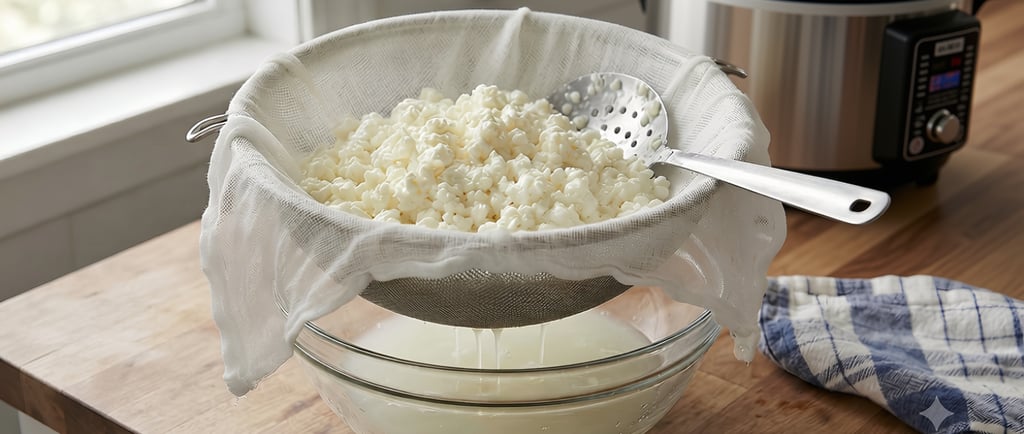
Transfer the remaining curds into a fine nylon mesh straining bag or a colander lined with butter muslin (avoid standard multi-layered cheesecloth to prevent clogging).
Toss or lift the curds gently to keep drainage pathways open and prevent matting.
5. Washing, Salting, and Creaming
Immediately pour ice-cold water directly over the warm curds in the strainer while gently tossing them with your hands to stop the cooking and rinse away sharp whey. Let drain thoroughly.
Toss the drained curds with a pinch of salt.
In a separate bowl, whisk together your heavy cream (or half-and-half) and salt. Combine the curds with the cream dressing to your preferred consistency.
Transfer to an airtight container and refrigerate for up to 7 to 10 days.
Join
Sign up for recipes, tips, and expert advice
Contact
Subscribe
hello@fermentedcuriosities.com
© 2026. All rights reserved.